Dame Antonia Romeo’s lecture at the LSE last Tuesday made the case for rewiring the state. Her big idea is small Frontier Teams inside departments, with an explicit licence to reimagine how public services are designed and operated, including the internal processes behind them, rather than just automating the tasks they already do. I know from the early days of GDS just how much that kind of freedom matters. The Cabinet Secretary rightly sees AI as a paradigm shift for government, and she made “appropriate guardrails” the overriding principle. I agreed with almost all of it.
So what should those Frontier Teams do with their licence to operate differently? I’d give them four things: new guardrails that let AI build safely, the freedom to form small, highly-expert multidisciplinary teams, the authority to ship, and a mandate to learn how AI agents use their services. What they shouldn’t do is go shopping for a chatbot here and a copilot licence there, however tempting the new £50m AI fund from the Budget makes it.
The UK has 361 councils that all collect bins, and each one tells you when in its own slightly different way. I recently built WhenIsBins.com to bring them together, and to learn how to make services with AI, and for AI agents.
Here’s what it taught me.
Build better guardrails, run by the best people.
WhenIsBins.com leans hard on the GOV.UK Design System, so my LLMs created a simple, clear, fast and accessible service out of its patterns, components and code. Most of the design and accessibility work had already been done by people who’d spent years researching what works.
If guardrails are the overriding principle, AI-native public services need them for privacy and data protection, user research, plain-English content, technical architecture, APIs and data standards, secure code, identity assurance and delegated authority, cyber and operational resilience, service ownership and many more.
Some of this wisdom already exists, written for humans via documents like the Service Standard and the Technology Code of Practice. They need fleshing out and rebuilding as new platforms that AI builds on, so that services made with AI follow these guardrails more faithfully than we humans ever managed. They need running by government’s best people and evolving constantly, just like the design system. Without them, AI will help teams build lots of fast, inconsistent services that nobody can safely run.
Don’t build alone.
My worst mistakes on WhenIsBins.com came from working alone. No user researcher asked who actually struggles to find their bin day. Nobody warned me that one council’s quirky street search was a dead end before I’d burned several evenings on it. AI makes a small team dramatically faster. It doesn’t replace the arguments a good team has on day one, which is where you spot the problems you can’t see yourself. Every Frontier Team needs that mix of skills and experience.
Build with AI, run without it for now.
I kept AI out of running WhenIsBins.com. I just used the LLMs to collect all the data and write all the code. Ask it the same question twice and you get the same answer, from code anyone can read and test. Boring, maybe, but that’s how trust is earned.
For benefits, tax or health, such deterministic assurance is non-negotiable, not least legally. Hopefully over time Whitehall will get good enough at forensically defining and evaluating what good looks like in terms of automated decisions, at which point I might have more confidence in government using LLMs to make impactful decisions as part of a public service. But for now, here be dragons.
Learn how AI agents behave.
Every technology revolution brings two waves of change. The first improves how an organisation does what it already does. The second reinvents what it does, because people’s behaviours and expectations have changed. Most of the speech was about the first wave.
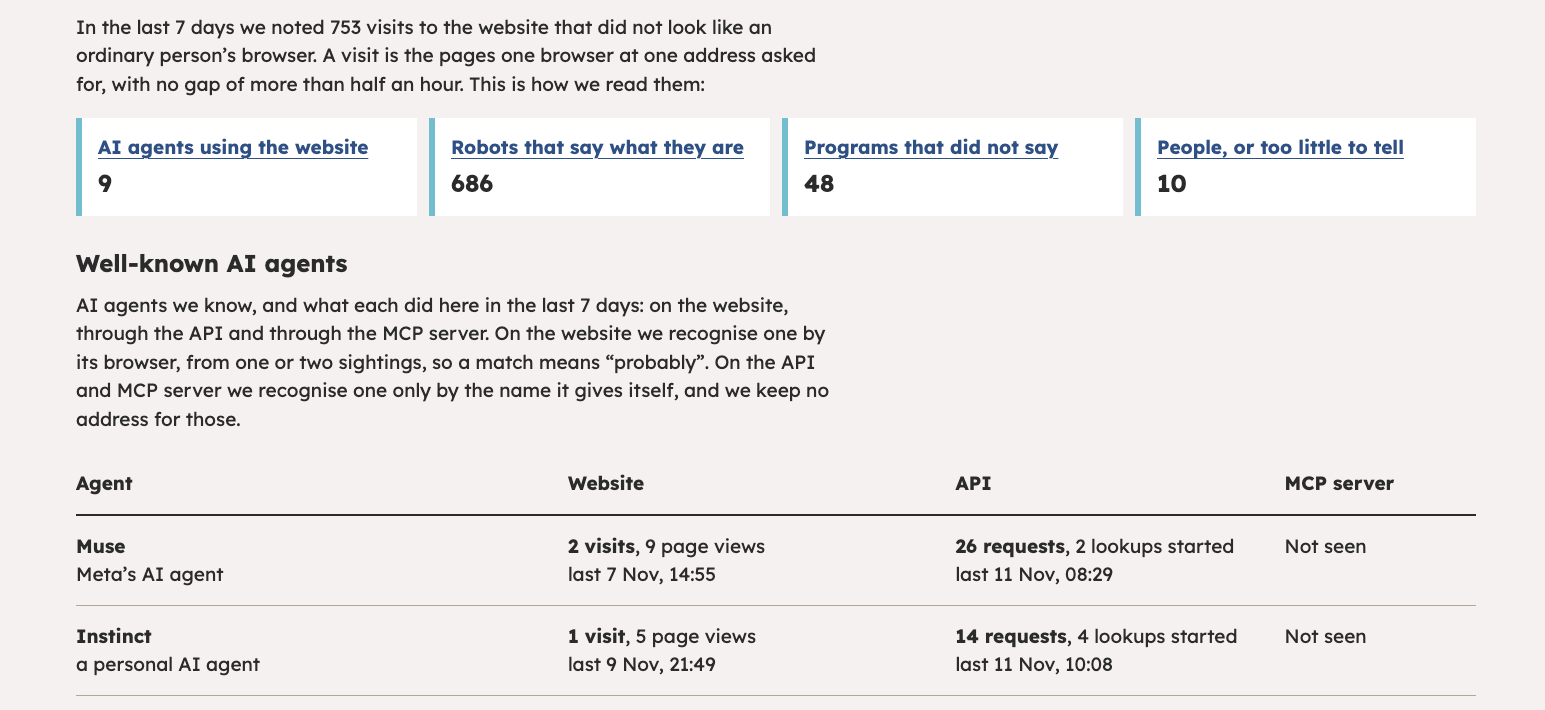
The second matters more, so watch how people’s behaviours and expectations are changing more closely than you watch the tech. Before long, I’ll wager many won’t use your service through a browser at all. They’ll send an AI agent. A chatbot answers your questions. An AI agent goes and gets things done on your behalf. Meta’s new Muse agent is already doing this for a large US audience, and the other big tech player are bound to follow suit.
WhenIsBins.com is my safe place to watch how AI agents behave, and I can track and observe how the likes of Muse, Instinct, Claude Duet and Openclaw use the service on behalf of their humans. Civil servants need to do the same for every public service. Ask an agent to watch your inbox for train tickets and claim for Delay Repay whenever your train runs late, and it just gets on with it. I have a hunch personal AI agents could herald as big a change as the internet, and they’ll join up government long before government joins up government.
Agents will be a boon to people shut out of public services by their complexity. They’re also doggedly relentless. Plenty of services quietly rely on being slow, confusing or tiresome to keep demand down, because people give up. Agents don’t, so expect demand to rise, sometimes alarmingly. Most appeals and complaints processes won’t survive in their current form.
Be bold where it matters.
Building WhenIsBins.com by myself without a complete set of guardrails was low risk. If it got a date wrong, the worst that could happen was an overflowing bin. But government can’t stop at bin days. Trust in its ability to deliver is already draining away. Romeo herself pointed out that only four in ten people now trust the Civil Service. Small, safe pilots won’t win that back. With the right guardrails in place, Frontier Teams should use AI to reimagine some mainstream services people rely on most.
Some will call such reimagination brave, in the Whitehall sense of the word. I’d call it long overdue.
PS If anyone would like to have a play with an AI Agent, please do contact me as I have a handful of fresh invites to Instinct’s beta.


Leave a Reply